Psychology for the Self-Learner, the complete series.
What if the defining feature of the major therapy orientations is not what each proposes but what each refuses to accept from the others?
An eight-volume curriculum for the determined reader.
The series ↓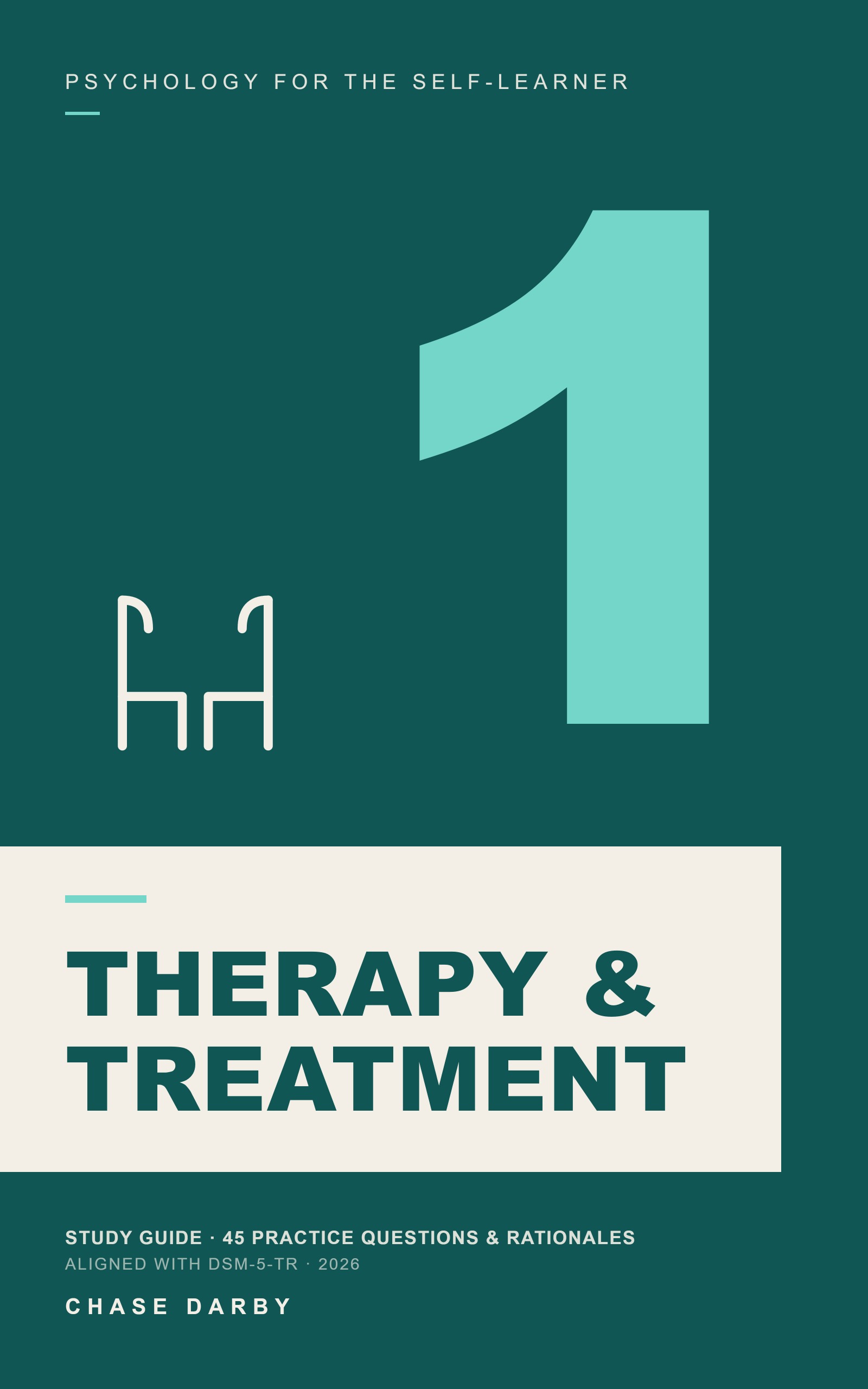



“Placebo groups consistently show better outcomes than no-treatment controls, confirming that factors such as hope, therapeutic contact, and the expectation of change carry genuine healing power.”
The argument for a book.
The usual approach to this material is a lot of lists. These are not books of lists or flashcards, or tips. They're a resource for you, from one learner to the next, about all of the ways we've been missing out on engaging with the hard ideas. Every volume reads front to back while the collection builds on itself. When something in one book connects to something three books later, I'll tell you about it, and I'll tell you why it matters.
Footnotes flag the places where textbooks disagree, and where the answer you usually see might be narrower than what the real world has been saying lately.
Every practice question comes with an explanation — not just the answer.
“Where clinical psychology asks what is wrong with the person, community psychology asks what is wrong with the context.”
Read a passage.
Most readers know repression and denial. The rest of the classical toolkit is subtler: reaction formation, projection, projective identification, splitting, intellectualization. Understanding them gives you a different perspective on a lot of seemingly ordinary human behavior.
The Classical Defense Mechanisms
The classical defense mechanisms differ in their maturity, the degree to which they distort reality, and their clinical implications. Repression is the most fundamental: it involves the involuntary rejection from consciousness of memories, thoughts, or experiences that are shameful or painful. Because repressed material is held outside awareness by an active unconscious process, it is less accessible to therapeutic intervention than material the client has simply avoided thinking about.
Denial involves a more sweeping refusal of reality: feelings, thoughts, or needs that would provoke anxiety are simply disavowed, as though they do not exist. Where repression acts on specific memories or impulses, denial can encompass entire dimensions of experience.
Reaction formation replaces an unacceptable impulse with its opposite. The original urge is denied, and a substitute that directly contradicts it is expressed in its place, often with exaggerated intensity. A person harboring hostile feelings toward a colleague, for example, may become conspicuously solicitous. The telltale sign of reaction formation is the rigidity and excess of the substitute behavior, which lacks the flexibility of genuine feeling.
Projection attributes the individual's own unacceptable wishes or impulses to another person. In Freud's model, projection is the mechanism that explains paranoia: the individual who cannot tolerate their own hostile impulses perceives hostility as originating in the external world.
Projective identification goes beyond simple projection.¹ In projective identification, the individual transfers unwanted aspects of the self onto another person, but the process does not stop there. Through subtle interpersonal pressure, the recipient is induced to experience and enact the projected material, creating a situation in which the projector feels merged or "at one" with the object of the projection. The mechanism is interpersonal in a way that simple projection is not: it reshapes the relationship between projector and target, and it is central to psychodynamic understandings of borderline pathology and the intense countertransference reactions that characterize work with severely disturbed clients.
Splitting involves relating to external objects as either entirely good or entirely bad, with no integration of positive and negative qualities into a coherent whole. A person using splitting may idealize a therapist one week and devalue them the next, without any sense of contradiction. Like projective identification, splitting is particularly associated with the object relations tradition and with the understanding of borderline personality dynamics.
Sublimation stands apart from the other defenses as the most adaptive. It transforms libidinal or aggressive energy into socially valued activities, channeling the underlying drive without distorting reality or generating symptoms. Creative work, intellectual achievement, and athletic competition are classic examples. Because sublimation satisfies the drive in a modified but genuinely gratifying form, it does not produce the internal tension characteristic of less mature defenses.
Eight volumes. Eight domains.
Click any section to reveal what that part covers.
1Volume 1 · 2 partsTherapy & Treatment
Part 1Individual Therapy Orientations
What if the defining feature of the major therapy orientations is not what each proposes but what each refuses to accept from the others? Psychoanalytic theory locates pathology in unconscious conflict; the humanistic and existential approaches insist on the person's capacity for growth; the cognitive-behavioral tradition claims that systematic change in thinking can relieve suffering. Together they establish the conceptual vocabulary every subsequent therapeutic approach inherits or deliberately discards.
Part 2Therapeutic Methods & Outcomes
The major therapy schools provide conceptual orientation, but they do not exhaust the clinical toolkit. The approaches gathered here range from paradoxical symptom prescription and family systems work to structured behavioral techniques and brief crisis interventions. Binding them is a question the outcome research takes up directly: across all these modalities, what actually predicts whether a client improves?
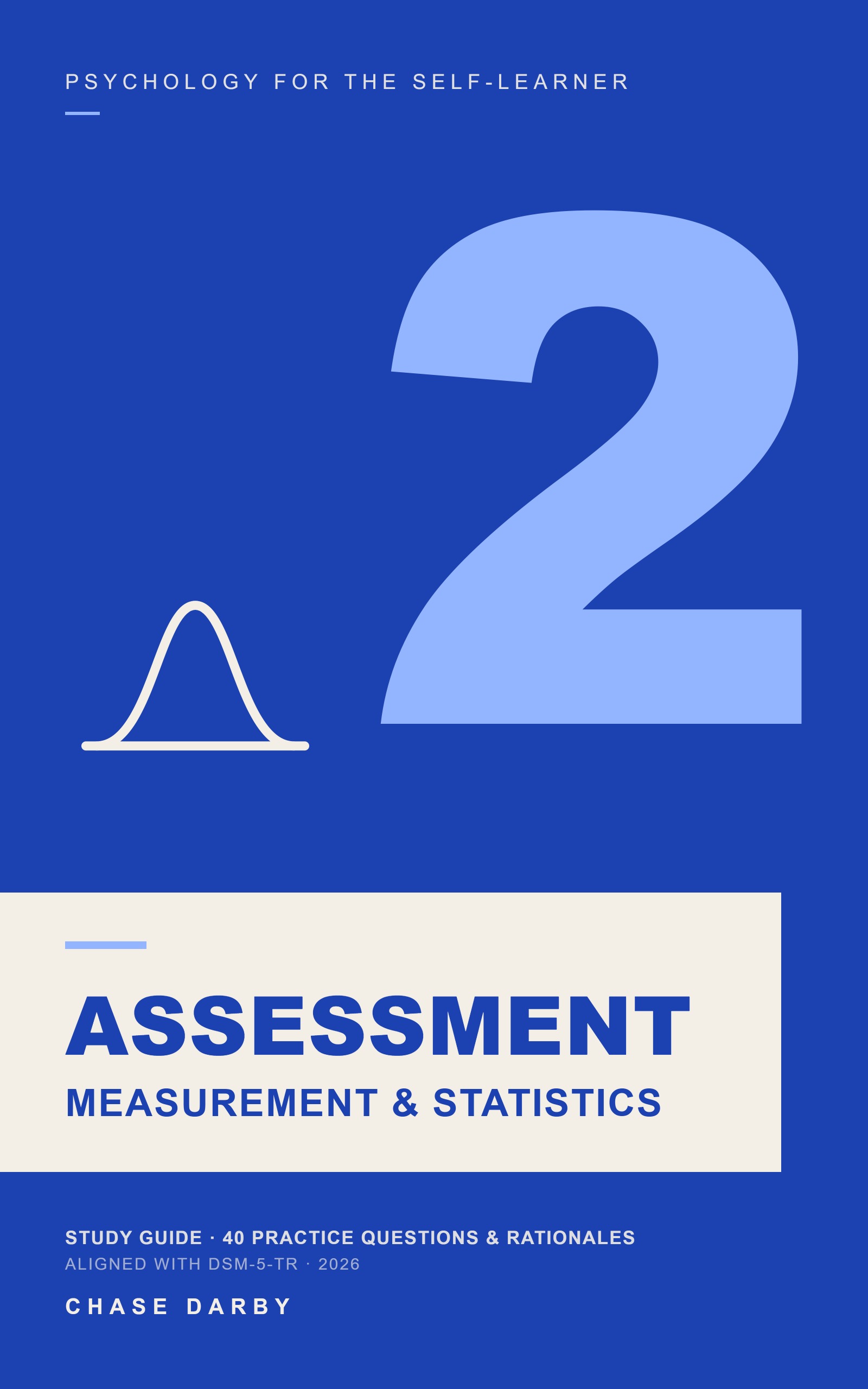
2Volume 2 · 2 partsAssessment, Measurement & Statistics
Part 1Assessment & Psychometrics
Every psychological test rests on a claim about where meaningful individual differences live and how they can be captured. Underlying all of them is a set of assumptions about measurement itself — assumptions that classical test theory, reliability analysis, and validity evidence allow the clinician to evaluate rather than accept on faith.
Part 2Research Methods & Statistics
How do we know whether a finding is real? Research design provides the logic of control. Statistics provide the quantitative language that transforms observations into evidence. Together they constitute the evaluative framework for every empirical claim in the discipline.
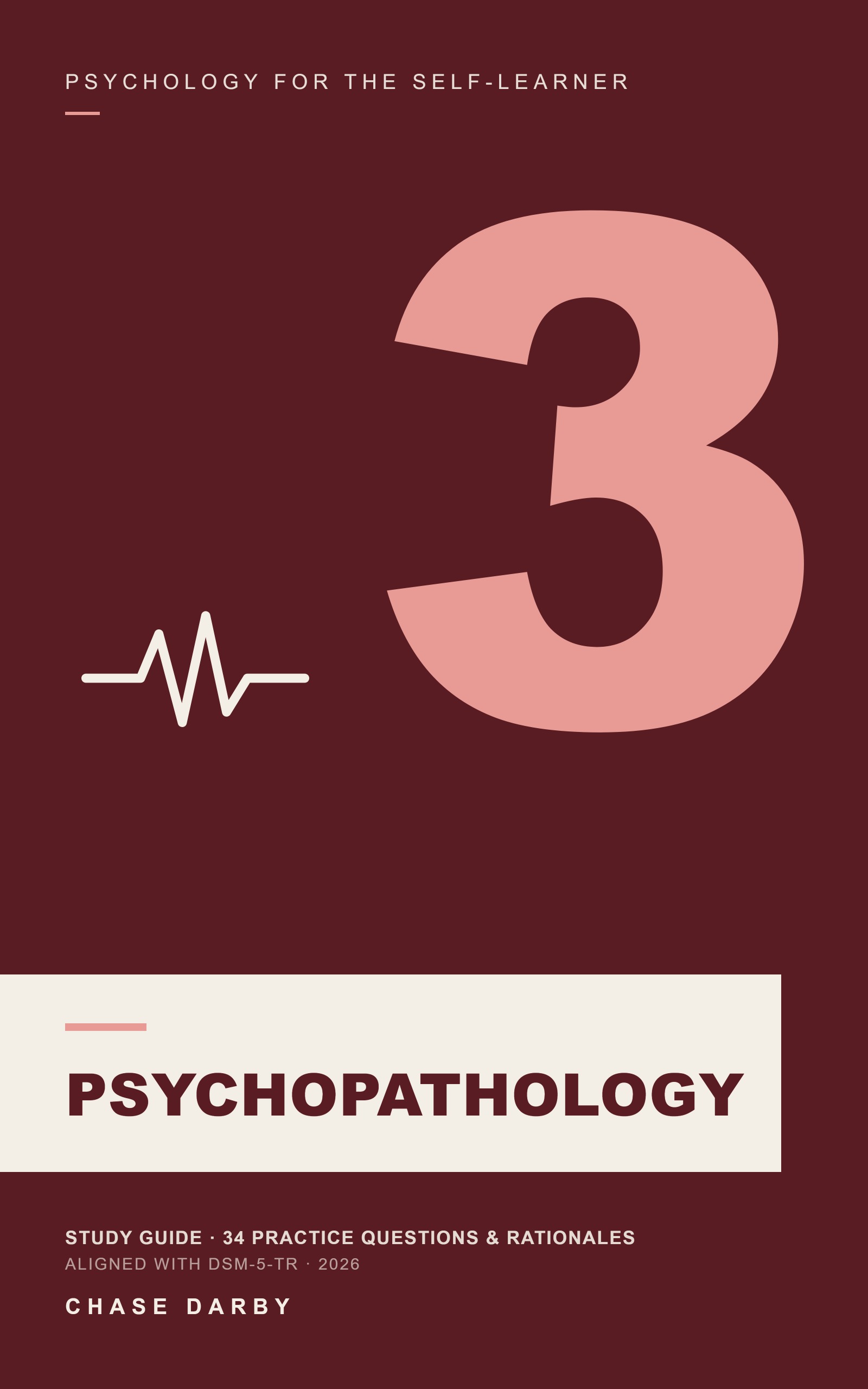
3Volume 3 · 4 partsPsychopathology
Part 1Disorders of Childhood & Adolescence
The disorders most commonly diagnosed in childhood are rooted not in departures from baseline functioning but in the trajectory of development itself. Understanding them requires a diagnostic framework that can distinguish delayed development from disordered development and both from normal variation.
Part 2Cognitive, Anxiety & Personality Disorders
The disorders gathered here share overlapping presentations but differ fundamentally in their mechanisms. The personality disorders describe not a departure from baseline functioning but the baseline itself — enduring patterns so ego-syntonic the individual rarely experiences them as pathology.
Part 3Psychotic & Mood Disorders
Schizophrenia severs the individual's contact with consensual reality; the mood disorders distort affect so profoundly that cognition, motivation, and biological rhythm bend under the weight. Despite this conceptual distinction, the two families overlap in important ways.
Part 4Other DSM Disorders & Conditions
The conditions gathered here share no common mechanism or etiology. What they share is a position at the margins of the major diagnostic categories — clinically significant patterns that do not fit neatly within the anxiety, mood, psychotic, or personality disorder families.
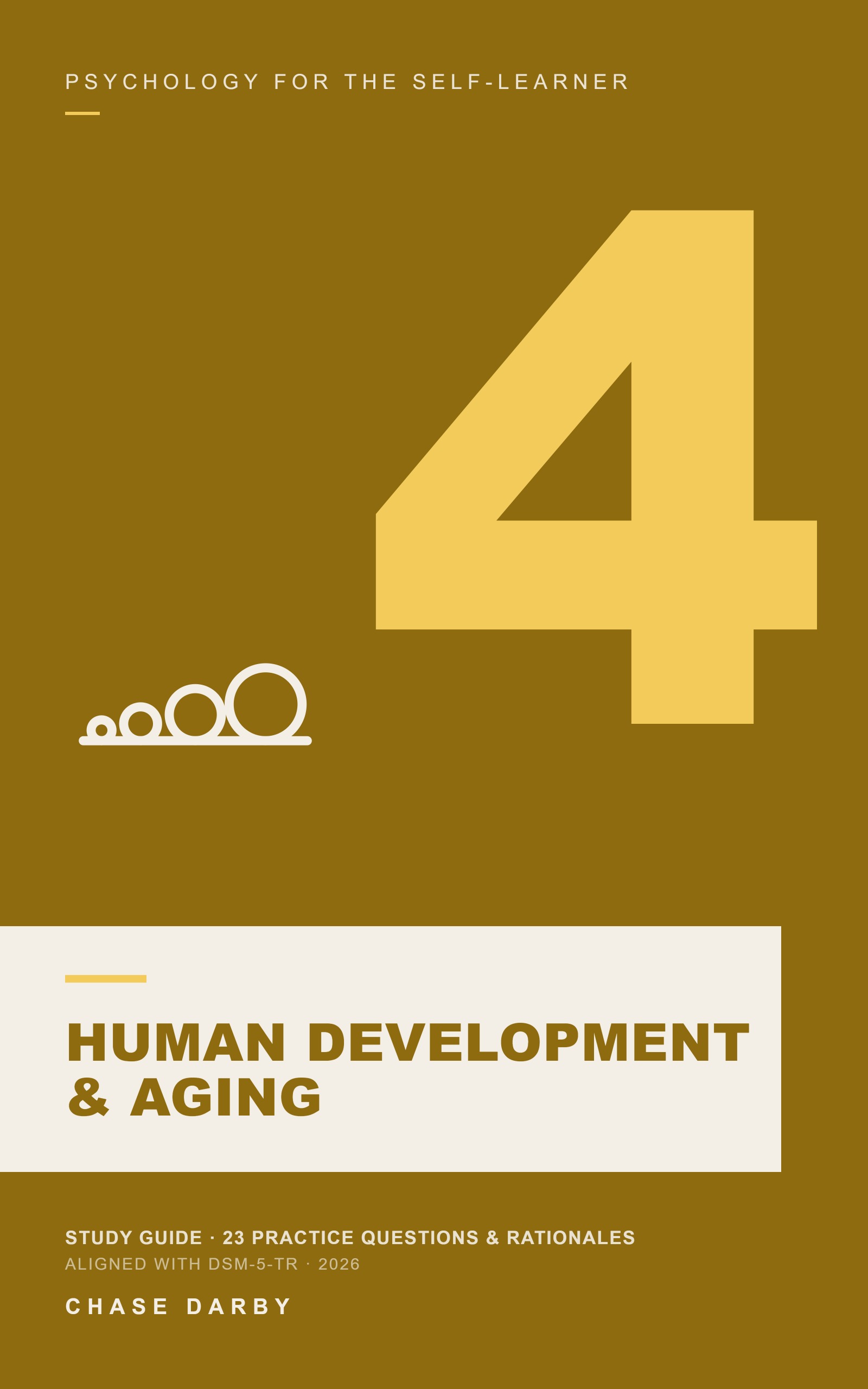
4Volume 4 · 2 partsHuman Development & Aging
Part 1Foundations & Cognitive Development
How does biological potential become cognitive capacity? The answer begins before birth, in the interplay between genetic inheritance and environmental experience that shapes prenatal development, sensory competence, and the physical substrate of the brain.
Part 2Social Development & Aging
Children do not develop in isolation. From the earliest months, human development is fundamentally relational. That relational arc does not end with adolescent identity consolidation: it continues through adult personality evolution, cognitive shift, and the confrontation with sexuality, loss, and mortality.
5Volume 5 · 2 partsBiological Bases, Learning & Memory
Part 1Biological Bases of Behavior
The biological substrate of behavior is not an academic abstraction: it is the foundation for understanding why SSRIs relieve depression, why hippocampal damage produces amnesia, why certain lesions abolish language while sparing music.
Part 2Learning & Memory
How do organisms learn, and how is what they learn retained? Classical and operant conditioning supply the foundational paradigms. But conditioning alone could not account for the cognitive territory that followed: insight, mental representation, observational learning, and the expectation-driven processes that Tolman and Bandura placed at the center of acquisition.
6Volume 6 · 2 partsSocial & Cross-Cultural Psychology
Part 1Cross-Cultural & Social Psychology
Human behavior does not unfold in a cultural vacuum, and social judgment does not emerge from dispassionate reasoning. The cognitive machinery behind social life operates largely outside deliberate awareness. In both domains, what people fail to recognize about their own perceptual frameworks is where the consequential errors occur.
Part 2Social Interaction & Applied Topics
What draws people toward some individuals and not others? When do bystanders help, and when do they walk past? The research on prosocial behavior, aggression, group dynamics, and conformity consistently demonstrates that situational forces exert far more influence on behavior than most people appreciate.
7Volume 7 · 2 partsEthics & Law in Psychology
Part 1APA Ethics & General Principles
The ethics code is not an appendix to clinical competence — it is the architecture within which competence operates. The distinction between aspirational principles and enforceable standards shapes every interaction a psychologist has with clients, students, supervisees, research participants, and the public.
Part 2Applied Ethics & Legal Issues
The ethical standards governing therapy, assessment, research, and education are not abstract principles but operational rules — specific enough to guide decisions and concrete enough to form the basis of formal complaints when violated.
8Volume 8 · 2 partsApplied Psychology: I/O, School & Community
Part 1I/O & School Psychology
Psychology applied to institutions produces two distinct but structurally parallel enterprises. In both domains, the laboratory principles meet institutional realities that reshape their application.
Part 2Community Psychology, Abuse & Violence
Community psychology represents a fundamental reorientation: away from the individual pathology model and toward an understanding of how environments, systems, and social structures shape mental health outcomes. Where clinical psychology asks what is wrong with the person, community psychology asks what is wrong with the context.
“Younger adults conceptualize their position in the lifespan as 'time since birth,' measuring forward from the beginning. Around midlife, this orientation shifts to 'time until death,' a reframing that fundamentally alters how individuals prioritize their remaining years and evaluate their accomplishments.”
The series.
Eight volumes, arriving in order. Volume 1 is out now; the rest are open for pre-order.
If you're here for an exam.
Know that I'm not here to compete with your prep courses. I'm here to complement them, and to give you the same resource I wished I'd had when I sat for my own exams. So much can threaten to derail your process leading up to that test date. I wrote these books to make the concepts clearer, so that one less thing will stand in the way.
The series ↑